
You Got Ghosted. Now What?
How to turn silence into momentum—with emails that actually work.


We have a patio tomato plant on our deck—a gift from my mom and, unintentionally, a great business lesson.
It started off full of promise: lush and green. And then… a heat wave hit, life got busy, and I forgot to water it for a few (okay maybe several) days. Suddenly, it was brown and crispy and I thought for sure it was a goner.
Still, I started watering it again. Daily-ish. And that sad little stem? It came back!! This week, we picked our first two (!) juicy, red tomatoes.
It felt familiar (too familiar…), like when a potential client ghosts you, and you’re not sure if it’s a no, or just not yet.
Sometimes, a lead goes quiet and you assume it’s dead. But if you keep showing up with intention and care, it just might come back to life… and actually bear fruit.
This post is about how to follow up with potential clients in a way that’s effective and true to you—not pushy, not awkward, not car-salesman energy. (And if you’re looking to get bolder in your close, I love Shelby Sapp and recommend checking her out.)
A Real-Life Revival
A few months ago, I had what felt like a slam dunk business development call. A trusted contact made the intro, I had an energizing 2.5-hour conversation with the CEO, and I turned around a proposal the very next day.
And then…
Crickets.
I assumed best intent—they’re busy! Something came up! I followed up a couple of days later.
Still nothing.
It dragged on like that for weeks. I spiraled. Did I price it wrong? Talk too much? Pick a weird Zoom background? Make an awkwardly offensive joke?
But I stuck with my system. As a marketer, I live by the Marketing Rule of 7: a potential customer typically needs to see or hear from you seven times before making a purchasing decision.
(The more expensive the service, the more touchpoints you need. This is why car companies have both billboards and Super Bowl ads.)
And here’s the twist: They came back! Weeks (maybe months?) later, we reconnected, updated the scope, and kicked off the project 72 hours after that.
Before You Follow Up: Set Yourself Up for Success
Great follow-up starts before the follow-up. It starts with how you show up on the initial call.
Step one: listen like it’s your job—because it is. Use the conversation to assess:
Are they someone you want to work with?
Do their values, pace, and vibe align with yours? Do they respect your time and expertise?Are they a real buyer?
Are you talking to the decision-maker? Are they actively ready to start, or just poking around?
Step two: listen for the gold.
Did they mention they’re heading to a concert this weekend? That their kid starts kindergarten this fall? That onboarding has been rough or they’re revisiting their family leave policy?
Small personal details + specific business challenges = cheat codes for follow-up that lands.
The Keys to a Great Follow-Up Email
Great follow-up has three essential ingredients:
1. A personal touch
Something that shows you’re actively thinking about them and their project. A quick callback to your last conversation goes a long way.
2. A small value-add
Show that you were really listening and thinking about how you could make their life easier. Share something helpful, thoughtful, or smile-worthy, like:
A relevant article, podcast, or event
A quick suggestion based on something they mentioned
A tool, template, or stat that connects to your earlier conversation
A screenshot of something that is working well or could be updated on their website
3. A clear next step
Make it easy for them to move forward. Examples:
“I went ahead and updated the contract—see attached. Let me know if you'd like to move forward.”
“Would you be free to reconnect Tuesday between 10–11am?”
“I’ll plan to circle back in September unless I hear otherwise.”
Your goal: leave them with one simple action to take after reading your note.
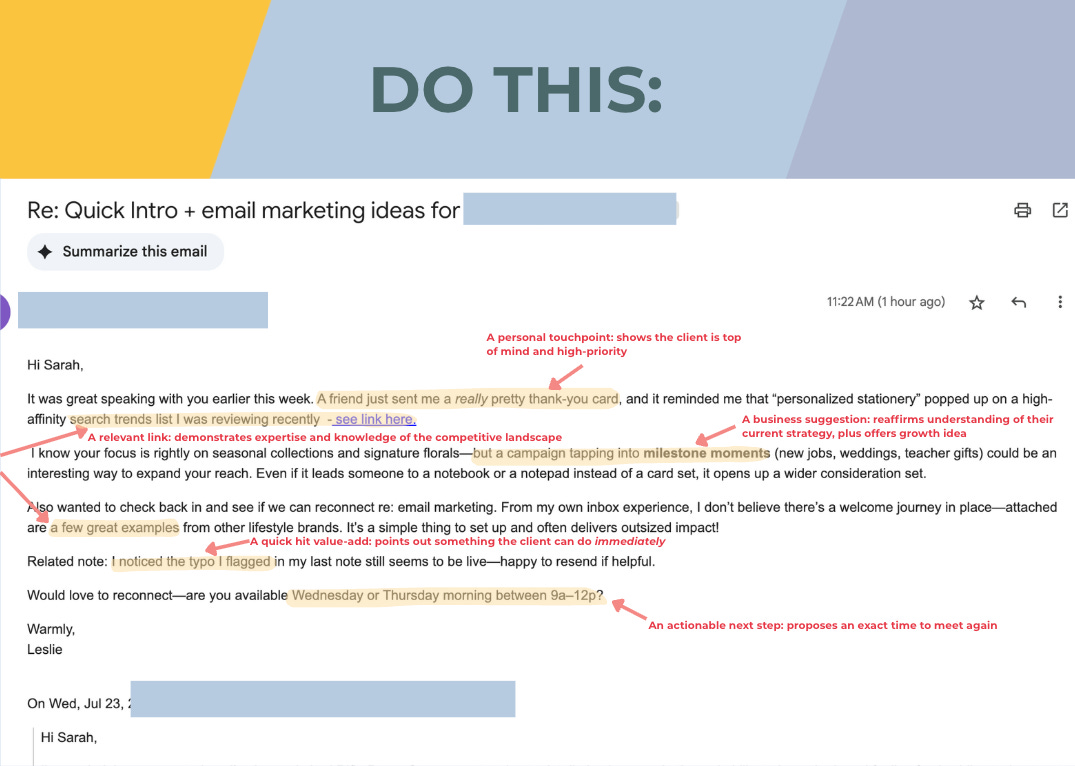
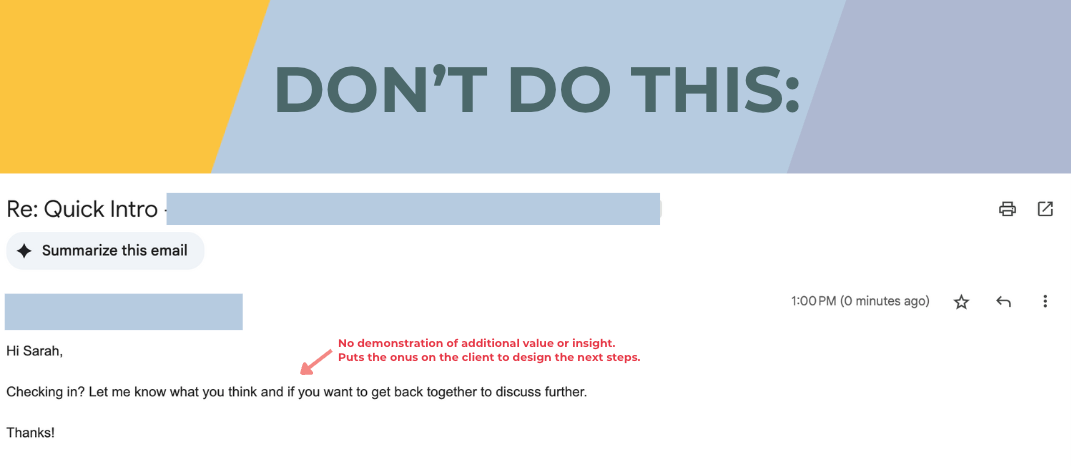
Follow-Up Framework (With Scripts!)
Here’s a simple structure based on real emails I’ve sent (after a business development call and sending an initial proposal for working together). Use them as a starting point and make them your own.
Follow-Up #1: 1–3 Days After Proposal
Goal: Nudge forward + optional time to reconnect
Subject: Quick follow-up
Hi [Name(s)],
Just following up to see if you had a chance to look over the proposal—did I capture what you’re hoping for? Let me know if anything feels off or needs adjusting.
Also happy to reconnect live. I’m available [insert 1–2 options] if either works for you.
Looking forward,
[Your Name]
Follow-Up #2: 3–5 Days After
Goal: Provide a light value-add + a concrete next step
Hi [Name],
Following up to see when works for you to reconnect about working together.
Quick heads-up: I noticed a small typo on [page/email/etc.]. Should be an easy fix.
(Or insert another value add from the list above.)
Let me know if [insert 1-2 days or time options] for a quick touch base.
[Your Name]
Follow-Up #3: 7–10 Days After
Goal: Share an insight + propose a call
Hi [Name],
I came across [relevant article, keyword trend, or campaign idea] and thought of our conversation—it might be a quick win or new angle worth exploring.
Also noticing [something helpful, like an onboarding gap or overlooked opportunity]. Could be easy to improve if we move forward.
I’m available [insert 2 time slots] to reconnect—let me know if either works!
Cheers,
[Your Name]
Follow-Ups #4–7: When It Feels Right
If you’ve followed up a few times and still heard zip, zilch, nada—it’s okay to pause. But it’s also okay to keep gently nurturing the lead.
At this point, your goal might no longer be to close ASAP. It’s to stay connected. A quick “thought of you” with a relevant resource is enough.
And even if you do pause for months—or a year!—it’s not too late. For independent folks, a year can feel like forever. But for corporate teams juggling quarterly priorities and approval layers, a year can fly by.
So if someone genuinely comes to mind, follow up. Thoughtful timing > perfect timing.
Script for a Long-Game Touchpoint
Goal: Keep the door open with a gentle nudge
Hi [Name],
Sharing this [article / campaign / update] that reminded me of our earlier convo—thought it might be helpful as you’re planning ahead: [link or quick summary].
If and when the timing makes sense to revisit the project, I’d love to reconnect. Always happy to pick things back up when you’re ready.
Warmly,
[Your Name]
Last Thing
If a lead doesn’t respond, it doesn’t mean you did something wrong.
Silence isn’t rejection. It’s just… silence.
Keep watering the seed. Keep showing up. Some leads bloom when they’re ready—and often, that’s weeks (or months!) after you expected.

 | A guest post by
|
 | A guest post by
|
Oh this is GOOD. When I'm on the receiving end of an email like example #2, it is so anxiety-inducing because the onus is entirely on *me.* Everyone just wants you to hold their hand through any big decision, and an email that essentially says "HEY why won't you answer me?" is so off-putting and puts one more thing on my plate to figure out. Love all your ideas for real, authentic, helpful, hand-holding follow-up emails. 🤝
Oh how I could have used this article 2 years ago!! This is fantastic.